 Skip to content
Top RF Coaxial Connector Manufacturers for Global Buyers
Choosing the right Rf Coaxial Connector manufacturer is not a simple price comparison. Global buyers must examine electrical performance, mechanical strength, production consistency, and after-sales support. A connector may look identical in a catalog, yet perform differently at 6 GHz, 18 GHz, or higher frequencies.
Dr. Eric Bogatin, a respected signal-integrity expert, said, “The signal is not what we send; the signal is what we receive.” His statement explains why connector selection deserves practical testing, not attractive specifications alone. In real applications, engineers inspect return loss, insertion loss, impedance control, shielding effectiveness, and mating durability. They also review plating thickness, contact materials, cable compatibility, and environmental resistance. Small details matter.
This guide introduces leading Rf Coaxial Connector manufacturers serving international buyers. It considers product range, manufacturing experience, quality systems, customization capability, and documented test procedures. Reliable suppliers should provide clear drawings, sample verification, and traceable inspection records. They should also communicate honestly when a design needs improvement.
No ranking is flawless. Buyer requirements vary.
A laboratory may prioritize ultra-low loss performance. A telecom installer may value fast assembly and stable supply. An aerospace project may demand tighter controls, stronger materials, and long qualification cycles. I have seen product descriptions appear impressive while omitting essential frequency or tolerance data. That omission should invite questions, not assumptions. The strongest manufacturers combine engineering knowledge with repeatable production. They understand that one loose contact, uneven plating layer, or poorly controlled interface can weaken an entire RF system. This overview helps global buyers compare suppliers with greater confidence, while leaving room for careful verification before purchase.
RF Coaxial Connectors: Types, Functions, and Common Applications
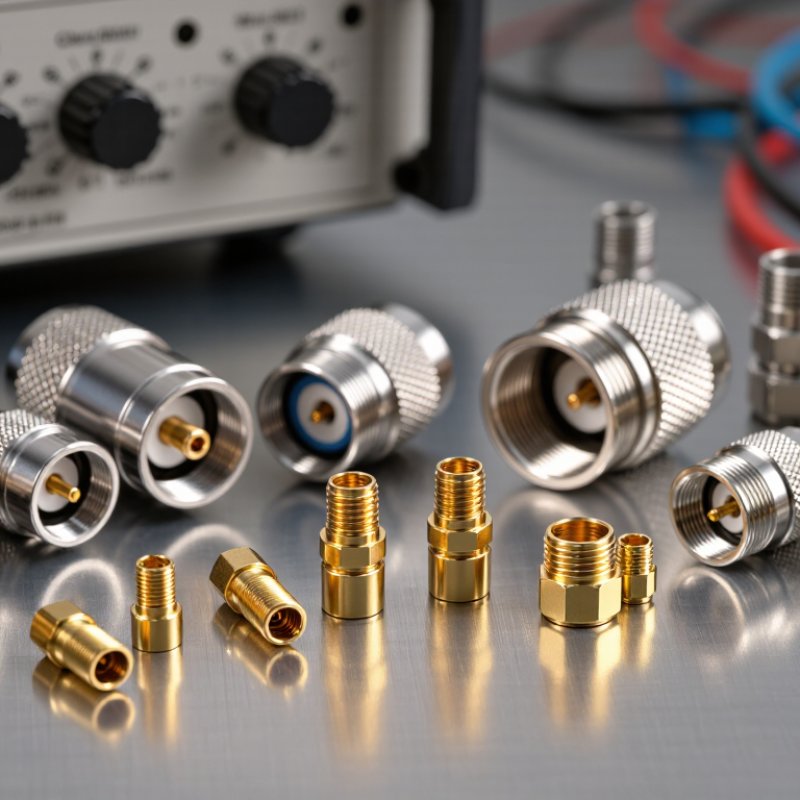
RF coaxial connectors transfer high-frequency signals between cables, antennas, radios, and test equipment. Their design controls impedance, shielding, and signal loss. Common types include SMA, N, BNC, TNC, and 2.92 mm connectors. Each suits different frequency ranges, environments, and mechanical demands.
SMA connectors are compact and widely used in wireless modules, GPS equipment, and laboratory instruments. N-type connectors provide stronger weather resistance for outdoor antennas and base stations. BNC connectors use a quick bayonet lock, making them practical for test benches and video systems. TNC connectors add a threaded connection, which improves stability under vibration. Precision connectors support advanced microwave testing, but they require careful handling.
The connector is only one part of the signal path. Cable diameter, plating, mating cycles, and installation torque also affect performance. A poorly tightened connector can create measurable reflection and intermittent faults. Field engineers often inspect the center pin, gasket, and cable braid before testing insertion loss. Not every connector fits every system. Global buyers should compare impedance, frequency rating, return loss, environmental sealing, and quality records from manufacturers. A lower purchase price may hide inconsistent dimensions or weak inspection controls. Even experienced teams sometimes overlook connector orientation during assembly. That small error can damage equipment or delay deployment. Testing a sample batch remains wise before placing a large order.
Top RF Coaxial Connector Manufacturers for Global Buyers - RF Coaxial Connectors: Types, Functions, and Common Applications
| Connector Type | Typical Impedance | Typical Operating Frequency | Coupling and Locking Method | Key Functions | Common Applications | Main Selection Considerations |
|---|---|---|---|---|---|---|
| BNC | 50 Ω or 75 Ω | DC to approximately 4 GHz, depending on design | Bayonet coupling | Fast connection and disconnection; reliable cable termination; convenient test-port access | Test equipment Video systems Instrumentation Radio systems | Choose the correct impedance and gender; avoid mixing 50 Ω and 75 Ω versions in precision RF paths. |
| SMA | 50 Ω | DC to approximately 18 GHz for common designs | Threaded coupling | Provides a compact, mechanically secure connection for microwave and RF signals | Antennas RF modules Wireless equipment Laboratory instruments | Suitable for high-frequency applications; torque control and connector cleanliness are important. |
| SMB | 50 Ω or 75 Ω | DC to approximately 4 GHz, depending on design | Snap-on coupling | Enables quick installation where space is limited; supports compact RF interconnections | Automotive electronics Telecommunications GPS equipment Instrumentation | Offers faster mating than threaded designs but generally has lower mechanical retention. |
| SMC | 50 Ω | DC to approximately 10 GHz, depending on design | Threaded coupling | Combines a small form factor with improved vibration resistance and secure retention | Avionics Industrial controls Mobile communications Test systems | Useful when a compact connector must withstand vibration or repeated handling. |
| N-Type | 50 Ω or 75 Ω | DC to approximately 11 GHz for common 50 Ω designs | Threaded coupling | Provides robust outdoor RF transmission, environmental sealing options, and good power-handling capability | Base stations Wireless networks Broadcast systems Outdoor antennas | Check weatherproofing, cable size, power rating, and frequency rating for outdoor installations. |
| TNC | 50 Ω | DC to approximately 11 GHz for common designs | Threaded coupling | Improves vibration resistance compared with bayonet-style connections while maintaining a compact interface | Mobile radios Aerospace systems Antennas Outdoor electronics | Appropriate for equipment exposed to vibration; verify sealing and cable compatibility. |
| UHF | Nominally 50 Ω; not constant impedance across its full range | Commonly used from DC to approximately 300 MHz | Threaded coupling | Supports economical, relatively large-diameter RF cable connections and moderate-power transmission | Amateur radio Legacy radio systems Audio-frequency links Low-frequency RF | Not recommended for precision microwave applications because impedance is not constant. |
| F-Type | 75 Ω | Usually DC to approximately 1 GHz; higher-rated versions are available | Threaded coupling | Provides low-cost 75 Ω transmission for coaxial cable carrying RF and broadband signals | Cable television Satellite receivers Broadband modems Home networking | Match the connector to the cable size and ensure the center conductor is correctly prepared. |
| 7/16 DIN | 50 Ω | DC to approximately 7.5 GHz, depending on design | Threaded coupling | Offers high power handling, low intermodulation performance, and strong outdoor durability | Cellular infrastructure Distributed antenna systems High-power transmitters Base-station feeders | Consider intermodulation performance, cable diameter, weather sealing, and installation torque. |
| 2.92 mm | 50 Ω | DC to approximately 40 GHz | Precision threaded coupling | Supports high-frequency test, measurement, and signal integrity characterization | Vector network analyzers Microwave test fixtures Radar development High-speed interconnect testing | Requires precision manufacturing, careful mating, and protection from mechanical damage. |
| 2.4 mm | 50 Ω | DC to approximately 50 GHz | Precision threaded coupling | Provides stable microwave performance and repeatable measurements at millimeter-wave frequencies | Millimeter-wave test Radar research Satellite communications Calibration systems | Use compatible precision adapters and inspect the interface before every critical measurement. |
| 1.85 mm | 50 Ω | DC to approximately 67 GHz | Precision threaded coupling | Enables very-high-frequency signal transmission with controlled impedance and low reflection | Advanced radar Sub-THz research High-frequency metrology Semiconductor testing | Designed for precision laboratory environments; connector interfaces must be handled carefully. |
| MCX | 50 Ω | DC to approximately 6 GHz, depending on design | Snap-on coupling | Provides compact RF connectivity for densely packaged electronic assemblies | GNSS devices Wireless modules Automotive electronics Portable equipment | Check board footprint, cable exit direction, retention force, and available installation space. |
| MMCX | 50 Ω | DC to approximately 6 GHz, depending on design | Snap-on coupling with rotational capability | Supports miniature RF assemblies where cable routing flexibility and low profile are required | Wearable devices Embedded antennas GNSS receivers Compact wireless products | Best suited to space-constrained designs; verify mating cycles and mechanical strain relief. |
Technical values are typical ranges for commonly available connector designs. Actual frequency limits, voltage standing-wave ratio, power rating, environmental protection, and mating-cycle performance depend on the specific connector, cable assembly, and manufacturer’s datasheet.